rtipc
RTIPC: Real-Time Inter-Process Communication
An inter-process communication library with near-zero overhead, specifically engineered to fulfill hard real-time constraints.
View C11 Repository • View Rust Repository
Core Features
- Zero-Copy and Syscall-Free: Data transfers instantly with absolutely no memory copying or kernel overhead.
- Deterministic Behavior: Data updates do not impact the runtime or execution predictability.
- Real-Time Message Handling: Features a “force push” operation. If the queue is full, the producer automatically discards the oldest unread message to make room for new data. This ensures the consumer always accesses the absolute freshest state.
- SMP Optimized: Messages are strictly cacheline aligned to minimize unnecessary cache coherence traffic across multi core systems.
- Event Notification: Optional
eventfdsupport for seamless integration with standard Linux event loops likeselect,poll, andepoll. - Multithreading: Multiple threads can communicate concurrently over separate, isolated channels.
Limitation: Both the message size and the maximum queue length are fixed at creation time to guarantee deterministic performance.
Formally Verified Algorithm
Because the “force push” operation increases algorithmic complexity, the underlying queue algorithm has been formally verified using SPIN/Modex to ensure correctness.
Why RTIPC?
The Architectural Problem
Modern software benefits heavily from the Unix philosophy: “Do one thing and do it well.” Splitting an application into multiple processes improves isolation, fault tolerance, and security. It also provides a clean migration path from legacy C/C++ to Rust, shielding new Rust components from common C/C++ memory bugs like wild pointers or use after free errors.
Why not standard Linux IPC?
While APIs like sockets, pipes, and System V/POSIX message queues exist, they introduce significant overhead:
- Sockets, Pipes and Message Queues: These require copying data from the producer to kernel memory, and then from the kernel to the consumer. (Even though pipes can use
vmspliceto avoid copying into the kernel buffer, the consumer still must copy the data out). - Standard Shared Memory: This eliminates copying but leaves the complex, error prone burden of process synchronization entirely to the developer.
RTIPC bridges this gap. It utilizes shared memory for zero-copy speed, backed by a Single Producer Single Consumer (SPSC) wait-free algorithm to handle synchronization safely, automatically, and deterministically.
Data Format and Serialization
When communicating between processes written in different languages, you need a common data format. While popular solutions like Protocol Buffers, Cap’n Proto, or FlatBuffers exist, none of them are recommended for this use case. Those serialization tools solve cross architecture compatibility, which is a problem that simply doesn’t exist in local IPC.
Because all your processes run on the same CPU architecture, standard C structs are the ideal format. Almost every general purpose language supports them natively:
- Rust: Simply decorate your struct with
#[repr(C)]. - Python: Access fields seamlessly via
ctypes.
Caveat: While it is technically possible to run a 32 bit process on a 64 bit CPU, attempting to communicate between a 32 bit process and a 64 bit process over shared memory will fail due to differing structure alignments.
Ensuring Consistency: rtipc-compiler
While full serialization frameworks are overkill, they do solve one major problem: schema-consistency.
To maintain a single source of truth across languages without runtime overhead, the rtipc-compiler project is currently being developed. While it is currently a proof of concept, its goal is to provide an Interface Definition Language (IDL) based on a subset of Rust syntax to automatically generate C compatible structs and classes across different target languages.
How It Works (Usage Workflow)
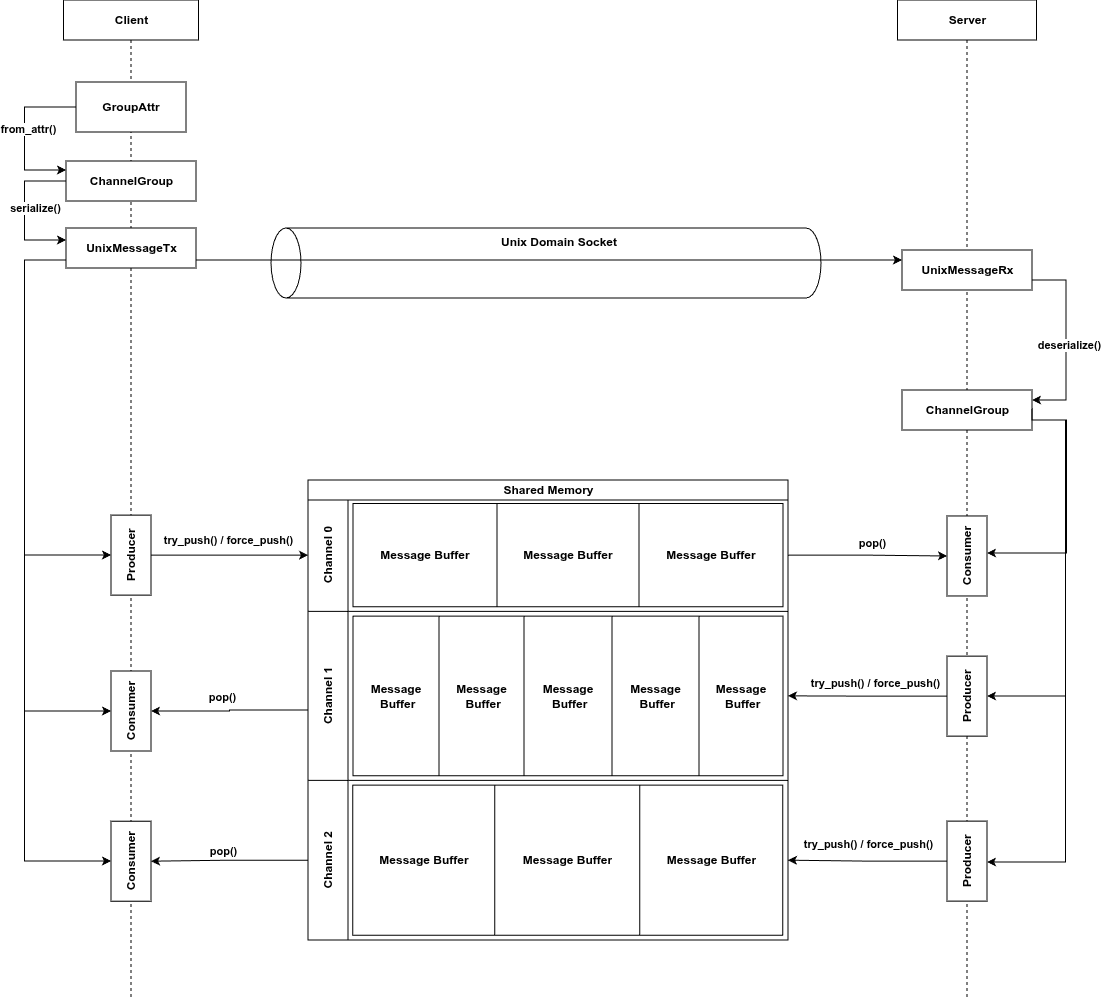
- Define Channels: The client configures a channel vector detailing the queue lengths, message sizes, optional
eventfds, and custom user metadata. - Allocate Resources: The library creates anonymous shared memory and
eventfds, then initializes the message queues. - Bootstrap via Unix Sockets: The configuration vector is serialized. The file descriptors (shared memory +
eventfds) are sent to the server via a standard Unix domain socket using native file descriptor passing (SCM_RIGHTS). - Establish SPSC Loop: The server deserializes the request, maps the memory, and both processes begin communicating directly via shared memory, bypassing the kernel entirely.
Alternative Bootstrap Methods
You can also use existing D-Bus infrastructure to handle the initial file descriptor exchange:
Ecosystem and Implementations
RTIPC is under active development. The ecosystem is designed to be lightweight, portable, and cross language ready.
| Language / Binding | Status | Repository |
|---|---|---|
| C11 | Active Development (Dependency Free) | rtipc |
| Rust | Active Development (Pure Rust) | rtipc-rust |
| Python | Active Development (via Cython) | pyrtipc |
| C++ | Planned (C Header compatible, RAII wrappers) | Coming Soon |
| Java / C# / Go | Planned | Coming Soon |